Medical Inflation at 16.9% in Singapore: What Rising Healthcare Costs Mean for Your Insurance and Your Wallet
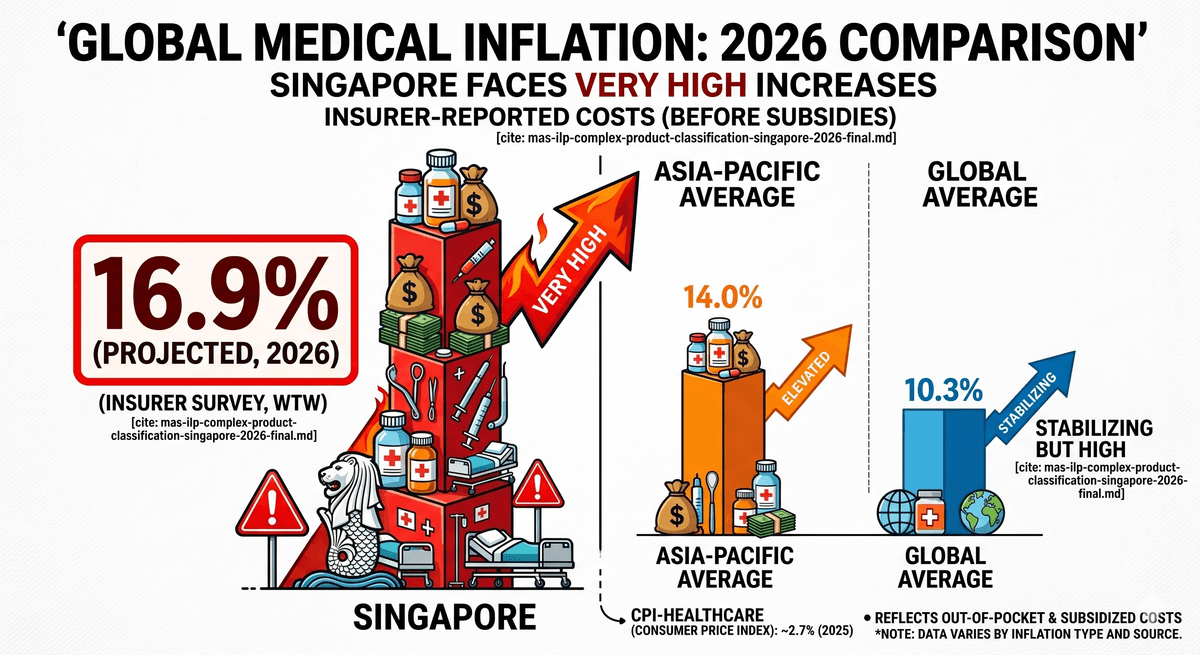
Singapore's insurer-reported medical inflation rate is projected to reach 16.9% in 2026 — the highest in the Asia Pacific region. Here is what is driving the numbers, how it affects both insured and uninsured residents, and what to check in your own coverage.
TL;DR — What to Check
- Medical inflation in Singapore is projected at 16.9% for 2026 — up from 15.5% in 2025 and 12.3% in 2024, according to the WTW 2026 Global Medical Trends Survey.
- Singapore's CPI-Healthcare rose 2.7% in 2025, but the insurer-reported rate was 15.5% — insurer claims are driven by private hospital treatments, where MOH transacted bill data shows the same procedure costs 4 to 12 times more than in a subsidised public ward, depending on the hospital.
- Asia Pacific is now the highest medical inflation region globally at 14% — with Singapore, the Philippines (16.1%), Malaysia (15.7%), and Indonesia (15.1%) all above the regional average.
- New IP rider rules from April 2026 mean higher out-of-pocket costs — the deductible is no longer covered by new riders, and the co-payment cap has doubled from S$3,000 to S$6,000. See the full breakdown of what changed.
- 74% of working Singaporeans remain underinsured for critical illness — according to the Life Insurance Association of Singapore (LIA) 2022 Protection Gap Study, and rising medical costs widen that gap further.
How Fast Are Medical Costs Rising in Singapore?
There are two ways to measure medical inflation in Singapore. They produce very different numbers because they measure different things.
The first is the Consumer Price Index (CPI) for healthcare, published by the Singapore Department of Statistics (SingStat). In 2025, CPI-Healthcare rose 2.7%, down from 3.9% in 2024. This measures what consumers actually pay at the point of service. Because Singapore's public healthcare system is heavily subsidised, consumer-facing prices are significantly cushioned — which is why this figure appears moderate.
The second measure comes from insurer surveys. According to the WTW 2026 Global Medical Trends Survey, which surveyed 346 leading health insurers across 82 countries, Singapore's insurer-reported medical inflation rate was 15.5% in 2025 and is projected to reach 16.9% in 2026. That is above the Asia Pacific (APAC) regional average of 14%, and more than 1.6 times the global average of 10.3%.
The gap between 2.7% and 15.5% does not mean one number is wrong. Two structural factors explain most of the difference.
First, the CPI captures what consumers pay at the point of service — after government subsidies absorb a significant share of cost increases. The WTW figure captures what healthcare is actually costing insurers in their claims books, before subsidies. The insurer number is where premium pricing comes from.
That cost pressure is visible in the CPI data itself. While the overall CPI-Health category rose 3.1% year-on-year in May 2026, the sub-components tell a split story. According to the SingStat CPI report for May 2026, outpatient care services rose just 0.6% and inpatient care services rose 2.1% — but the Health Insurance sub-component rose 12.6% on a five-month rolling basis (January to May 2026 versus the same period in 2025). The Health Insurance CPI index stands at 122.9 as of May 2026, against a base of 100.0 in 2024 — a 22.9% increase in roughly two years. The insurer-reported medical inflation rate of 15.5% in 2025 appears to be flowing through to consumer-facing premiums at close to the same magnitude.
Second, insurer claims are disproportionately driven by private hospital treatments, where costs are rising faster and are multiples higher than subsidised public care. According to MOH data presented in Parliament on 6 May 2026, average private hospital bills grew at approximately 13% per year from 2019 to 2024. Hospital-related fees — facility charges, ward fees, medication, and implant costs — make up about 60% of private hospital bills and grew at 15% annually over that period. Professional fees (surgeon, anaesthetist, consultation charges) make up the remaining 40% and grew at 9% annually.
The cost difference between care settings is significant. MOH's published bill size data, based on 2023 transacted bills, shows the median total bill for the same procedure across subsidised public wards and private hospitals:
| Procedure | Public Ward C (Subsidised) | Private Hospital Range | Private vs Ward C |
|---|---|---|---|
| Cataract surgery (day surgery) | S$974 | S$8,467 | 8.7x |
| Appendicectomy (inpatient) | S$2,526 | S$19,266 – S$30,808 | 7.6x – 12.2x |
| Knee replacement (inpatient) | S$7,143 | S$28,177 – S$49,789 | 3.9x – 7.0x |
Source: MOH Cost Financing portal, 2023 transacted bills (median, inclusive of GST). Private hospital ranges reflect variation across individual hospitals (e.g. Mount Alvernia to Mount Elizabeth). These three procedures are among the 65 most common procedures that account for 64.2% of all procedure-related admissions in Singapore.
Across these three procedures — spanning day surgery, emergency surgery, and major elective surgery — the private hospital bill ranges from 3.9 to 12.2 times the subsidised Ward C bill, depending on the procedure and the hospital.
MOH's own data also shows that IP policyholders with riders are 1.4 times as likely to make a claim, with an average claim size 1.4 times that of policyholders without riders. MOH has attributed this to a combination of over-servicing by healthcare providers and over-consumption by patients when out-of-pocket exposure is minimal.
In short: the CPI reflects the full mix of healthcare spending, dominated by subsidised public care. The insurer figure is weighted toward private hospital claims — where costs are higher, growing faster, and amplified by utilisation patterns linked to comprehensive rider coverage.
Over the past 20 years from 2005 to 2025, the CPI-Healthcare in Singapore increased by 59.1% — compared to 52.8% for headline CPI. Healthcare costs have consistently outpaced the general cost of living.
What Is Driving Medical Inflation in Singapore?
The cost drivers are structural, not temporary — and most of them are accelerating.
According to WTW's survey, the top three factors driving medical inflation globally and in APAC are:
| Rank | Cost Driver | % of Insurers Citing It (APAC) |
|---|---|---|
| 1 | New medical technologies | 77% |
| 2 | Advancements in pharmaceuticals | 63% |
| 3 | Little or no cost sharing | 51% |
In Singapore specifically, WTW identified additional local factors: an ageing population, a rise in disease incidence, improved early detection, long-term management of conditions such as cancer, diabetes and obesity, high operating expenses driven by real estate prices, and a shortage of healthcare staff.
Cancer is the single largest claims cost driver. According to WTW's 2026 report, over 50% of APAC insurers named cancer as the fastest-growing condition by both incidence and cost. In Singapore, cancer is the leading cause of death, accounting for 26.2% of all deaths.
A finding that applies across the entire region: 82% of insurers surveyed in APAC reported an increase in the incidence of cancer in the population under the age of 40 over the past year. Medical experts point to environmental and lifestyle factors linked to this uptick. Advances in treatments — including mutation-based methods and liquid biopsies — have improved care but are becoming increasingly expensive, particularly over the long term.
How Does Singapore Compare to the Rest of Southeast Asia?
Every major Southeast Asian market is now experiencing double-digit medical inflation — and relief is not expected soon.
Here are the projected 2026 medical inflation rates for APAC markets, as reported by the WTW survey:
| Market | 2024 | 2025 | 2026 (Projected) |
|---|---|---|---|
| Singapore | 12.3% | 15.5% | 16.9% |
| Philippines | 17.0% | 14.3% | 16.1% |
| Malaysia | 11.7% | 13.9% | 15.7% |
| Indonesia | 12.8% | 16.9% | 15.1% |
| Thailand | 9.8% | 10.8% | 10.8% |
| Vietnam | 10.3% | 10.7% | 12.3% |
| APAC Average | 11.8% | 13.2% | 14.0% |
Source: WTW 2026 Global Medical Trends Survey
The Mercer Marsh Benefits Health Trends 2026 report provides a complementary view. It projects Asia's overall medical trend rate at 12.5% in 2026 — close to six times the general inflation rate in the region. Mercer Marsh identifies increased utilisation from higher incidence of health conditions and advanced technologies as the underlying cost drivers.
57% of insurers in APAC expect these elevated medical cost trends to continue for at least the next three years. 42% expect them to persist for more than three years. The data, across both surveys, points to a sustained period of above-average medical cost growth.
What Does This Mean If You Have Insurance in Singapore?
Rising medical costs do not just affect hospital bills — they flow directly into insurance premiums, policy design, and out-of-pocket exposure.
Three developments in 2025 and 2026 illustrate the connection:
1. MediShield Life Premiums Are Being Phased In Over Three Years
Following the MediShield Life 2024 review, the government accepted recommendations to enhance the scheme's benefits and adjust premiums accordingly. The total premium increase is capped at 35% and is being phased in over three years, from April 2025 to March 2028. The government is providing S$4.1 billion in support measures — S$3.4 billion in MediSave top-ups and S$0.7 billion in premium subsidies — to offset the increases. Lower and middle-income Singaporeans receive premium subsidies of up to 60%.
2. New IP Rider Rules from April 2026 Increase Out-of-Pocket Costs
From 1 April 2026, new Integrated Shield Plan (IP) riders can no longer cover the minimum IP deductible (which ranges from S$1,500 to S$3,500 depending on ward class). The co-payment cap has also been raised from a minimum of S$3,000 to S$6,000 per year. In exchange, new private hospital rider premiums are expected to be about 30% lower on average.
The Ministry of Health (MOH) data behind this change: IP policyholders with riders are 1.4 times more likely to make a claim, and their average claim size is 1.4 times that of policyholders without riders. MOH's stated objective is to moderate healthcare costs by encouraging shared financial responsibility.
For policyholders, the practical impact depends on ward class and bill size. A 58-year-old undergoing knee replacement surgery at a private hospital with a total bill of S$62,480 would, under the new rider structure, pay both the deductible and co-payment — approximately S$6,449 — before the rider's co-payment cap takes effect. Under the previous structure, the out-of-pocket cap was typically around S$3,000.
See a full worked example of the April 2026 co-payment changes.
3. Insurance Premiums Are Rising in Step with Medical Costs
MediShield Life premiums are being increased by up to 35% over three years. Multiple IP insurers have announced significant premium hikes for 2026. The insurer-reported medical inflation rate of 15.5% in 2025 flows directly into how insurers price their premiums — and those costs are passed to policyholders.
Some individual IP riders have seen premium increases well above the average. For example, Raffles Health Insurance announced a 155% average increase for Raffles Key Rider premiums when attached to Raffles Shield Private, effective April 2026.
What Does This Mean If You Do Not Have Insurance?
For uninsured or underinsured residents, medical inflation compounds an already significant financial exposure.
All Singapore citizens and permanent residents are covered by MediShield Life, which provides baseline coverage sized for Class B2/C ward bills in public hospitals. But approximately 29% of the resident population does not hold an Integrated Shield Plan, meaning they rely on MediShield Life alone or on MediSave and out-of-pocket payments for costs above the basic scheme.
The LIA 2022 Protection Gap Study found that 74% of working Singaporeans have a critical illness (CI) protection gap — the financial shortfall between what they would need during a five-year recovery period and what their existing insurance covers. That translates to S$579 billion in unmet protection needs nationally. Among individuals aged 20 to 24, 83% lack sufficient CI coverage. Among platform workers — private-hire drivers, delivery riders — the CI protection gap is 91%.
In Singapore, the government's healthcare financing framework — MediShield Life, MediSave, MediFund — is designed to prevent catastrophic out-of-pocket costs for subsidised care. But for residents seeking private hospital treatment without an IP and rider, the full cost of medical inflation hits directly.
To understand what the CI protection gap means in practice — including the policy clauses most likely to reduce a payout — see Critical Illness Claim Payout Rules: 5 Hidden Clauses Your Policy Won't Tell You.
What Should You Check in Your Own Policy?
1. What is your IP rider structure — old or new?
If you purchased your IP rider before 27 November 2025, you may continue under the existing structure for now. Riders purchased on or after that date will transition to the new requirements no later than the next policy renewal after 1 April 2028. Check with your insurer or financial adviser whether your current rider is affected.
2. What is your deductible and co-payment cap?
Under the new rider rules, the minimum deductible ranges from S$1,500 (Class C ward) to S$3,500 (Class A / Private). The co-payment cap is now a minimum of S$6,000. Review your policy schedule to confirm your specific numbers.
3. Do you have a critical illness plan — and is the coverage amount current?
With medical inflation running at 15% to 17% annually at the insurer level, a CI plan purchased five years ago may cover a materially different amount of real-world cost than it did at inception. The LIA 2022 Protection Gap Study found that the average CI protection need per working adult in Singapore is approximately S$813,892.
4. Are you relying on MediShield Life alone?
MediShield Life covers Class B2/C ward bills in public hospitals and is sufficient for many Singaporeans using subsidised care. If you are considering private hospital treatment — or if you want coverage for higher ward classes — an Integrated Shield Plan provides additional coverage. MediShield Life premiums are being increased over three years (April 2025 to March 2028), capped at 35%.
Upload your policy to InsureIQ and ask: "What is my current deductible and co-payment cap?" or "Does my critical illness coverage keep pace with medical inflation?" InsureIQ will find the relevant clause, explain it in plain English, and flag what has changed under the April 2026 rules.
This article is for informational purposes only and does not constitute financial advice. Policy terms vary by insurer and plan. Always refer to your specific policy document for exact coverage details.
Get the next article
New articles on Singapore insurance policy gaps, claim denials, and regulatory changes — delivered to your inbox when published. No spam, no weekly digest.
Free. Unsubscribe any time. InsureIQ will not share your email.