Your Critical Illness Policy Might Not Cover the Illness That Kills You
A Singaporean paid premiums for years. His insurer said the tumour was not life-threatening enough. He got nothing. Medicine has moved on — most CI policies have not. Here is what that gap costs policyholders, why surrendering your old policy is usually the wrong fix, and what to do instead.
Singapore's Critical Illness Gap Is Not a Fringe Problem
Around the same time, a thread appeared on Reddit's r/singapore with a simple, exhausted title: "Done dirty by Singlife." A policyholder described a cancer-related CI claim being rejected under their Singlife MultiPay CI policy. The post resonated immediately — upvotes, shares, and comment after comment from Singaporeans who recognised the pattern or feared they were in the same position without knowing it.
The community's verdict was blunt: "pls check if you have this Singlife MultiPay CI policy. if suay might end up in the same situation."
One commenter put it plainly: "LIA encourages insurers to update their policies whenever definitions change and inform their policyholders — but other companies are doing the same, ignoring LIA's lip service."
That observation cuts to the heart of the problem.
How Singapore's CI Framework Got Left Behind
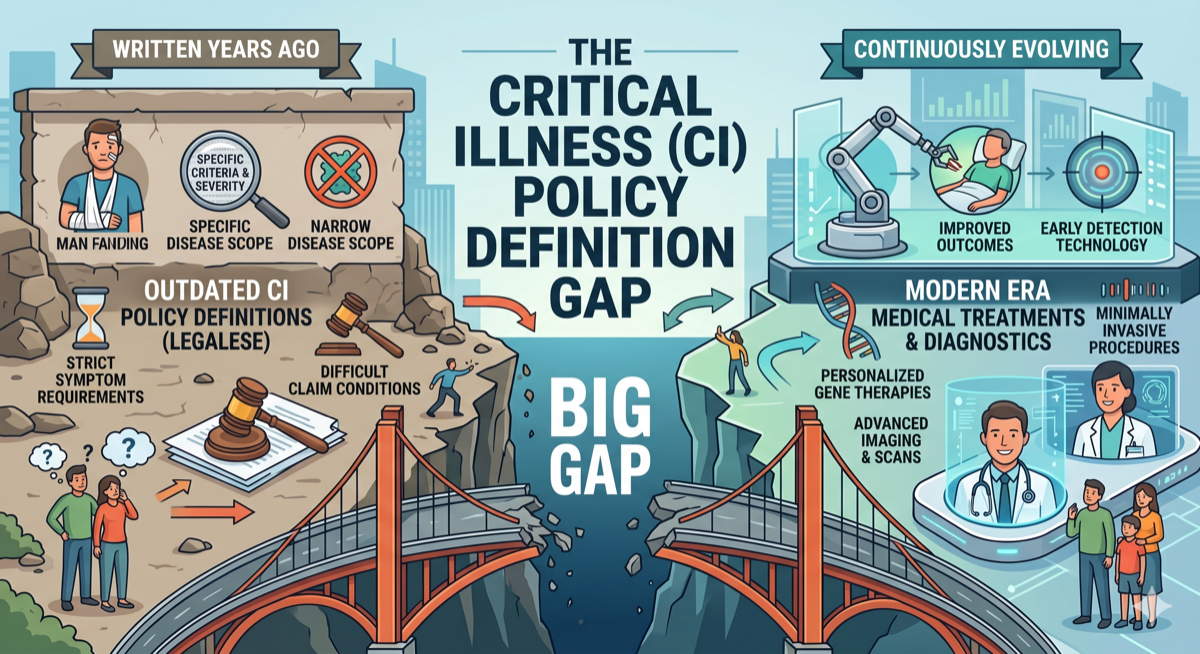
The Life Insurance Association of Singapore (LIA) publishes standardised definitions for 37 critical illness conditions. These definitions — the literal words that determine whether your claim is paid — have been updated just four times in the history of CI insurance in Singapore: before 2003, in 2003, in 2014, and in 2019.
The 2019 framework became the industry standard. It remained so for six years.
Six years during which:
- Liquid biopsies became capable of detecting cancers years before they become symptomatic
- High-sensitivity troponin tests redefined what constitutes a "heart attack"
- Keyhole cardiac procedures replaced open-chest surgery as the standard of care
- Immunotherapy converted previously terminal diagnoses into manageable chronic conditions
LIA circulated the CI Framework 2024 to its members in 2024 and reissued it in final form on 13 May 2025 — the first meaningful update in six years — with a hard implementation deadline of 1 October 2025. From that date, products using the Version 2019 definitions may no longer be sold in Singapore. The stated objective of the review was to bring the definitions "up to date and aligned with advances made in medical technology and medical practice as well as to address areas of ambiguity."
Read that again: the industry's own association acknowledged, in writing, that the existing definitions created ambiguity for policyholders making claims.
What Actually Changed — and What It Reveals About What Was Wrong Before
The 2024 framework updates are instructive not just for what they add, but for what their existence admits about the old definitions. Here are some of the changes:
Open-Heart Valve Surgery — The 2019 heading was "Open Chest Heart Valve Surgery." The 2024 version drops the chest-wall requirement, asking only for "an incision on the heart for the direct visual replacement or repair" — so minimally invasive surgery that still opens the heart should now qualify. Two exclusions remain: procedures performed "via endoscopic or keyhole surgery" or "via catheterisation." Transcatheter valve work such as TAVI therefore stays outside this benefit, as it did under 2019.
Heart Attack — The definition of "Other Serious Coronary Artery Disease" was revised to provide "clearer understanding of the real intention and requirements." In plain English: the old definition was unclear enough that insurers and policyholders interpreted it differently. Policyholders lost those disputes.
Cancer — Updated to reflect the WHO's 2022 reclassification of pituitary neuroendocrine tumours (PitNET) as a distinct entity. The fact that a definitional update had to track a 2022 WHO taxonomy change that took until 2025 to implement illustrates the lag precisely.
Deafness — Now defined with a specific decibel threshold (80dB or greater across all frequencies). Before this, "total" hearing loss was vague enough to dispute.
Every one of these changes represents a category where, under the old framework, a legitimate claim could be — and was — denied.
A word of caution about the word "keyhole." It is a lay term, not a technical one, and Singapore hospitals routinely describe mini-thoracotomy to patients as keyhole surgery. The distinction the valve definition actually turns on is narrower: whether the surgeon repaired the valve under direct vision through a small incision, or worked from a camera image. The first should qualify; the second is excluded. So if your operation note or discharge summary uses "keyhole" loosely to describe what was in fact a direct-vision repair, an insurer may reach for the exclusion regardless. At claim time, what governs is the wording your surgeon wrote down — which makes it a question worth raising before the operation rather than after.
The Catch: Your Old Policy Does Not Automatically Update
This is the critical detail most Singaporeans holding CI policies do not know.
The 2024 framework mandates that new policies issued from 1 October 2025 must use the updated definitions. It does not automatically update existing policies.
And the position is firmer than most people assume. This is not a case of insurers quietly ignoring a recommendation they were free to follow. LIA's own Industry FAQ puts the question to itself — can I request for the CI definitions of my existing policy to be updated to the latest definitions? — and answers it without ambiguity:
No, such an update is not possible. Your existing CI policy is not impacted. Once issued, the insurance contract is legally binding on both parties.
And if you were hoping a lapse and reinstatement might quietly refresh the wording, the FAQ closes that door too: insurers "cannot unilaterally change the contract by applying the latest definitions at the time of reinstating the policy."
There are only two narrow openings, and both are at the insurer's discretion rather than yours:
- Renewals. For a yearly renewable CI term policy, "insurers can choose to apply the latest definitions in respect of existing policy renewals." Choose — not must.
- Top-ups and increases in cover. Where you add sum assured to an existing policy, the insurer may apply the current definitions to the increased portion only, and must disclose that it is doing so. LIA's own worked example: a S$100,000 policy bought in 2020 topped up by S$50,000 in 2026 produces a claim in 2028 assessed under Version 2019 for the first S$100,000 and Version 2024 for the S$50,000 — one illness, one claim, two different rulebooks.
If you bought your CI policy in 2018, 2020, or even 2023, you are governed by definitions that the industry itself has now publicly acknowledged needed updating — and there is no mechanism by which you can ask for that to change. Nobody is required to tell you. Many will not.
Parliament has taken notice. Written parliamentary questions have been raised on the government's monitoring of insurance claim denials and the number of complaints MAS has received regarding disputed claims — a signal that this is no longer just a consumer advocacy issue.
Could Your Insurer Simply Pay Under the Newer Definition Anyway?
No — not as a contractual right. LIA's own Industry FAQ states that claims are assessed against the definitions in each individual policy contract, and that an insurer will not pay based on the better-off definition if you hold policies written under different versions. Insurers can and sometimes do make discretionary ex-gratia or goodwill payments, but these are case-by-case commercial decisions, not entitlements you can rely on.
This is the question most policyholders ask once they understand the gap, and it deserves a straight answer rather than a comforting one.
LIA's Industry FAQ asks precisely this — when I am insured under different CI versions, can the insurer pay based on the better-off definition? — and the answer is one word long, followed by the reasoning:
No, claims assessment and benefits will follow the definitions and terms and conditions stated in each policy contract in question.
If you hold two policies bought in different years, each is assessed against its own wording. The more generous definition in the newer contract does not bleed across to the older one. Do not plan around the assumption that it will.
In practice, there is a narrower and much less certain avenue. Insurers in Singapore do sometimes make ex-gratia or goodwill payments — settlements offered without admitting that the contract required them, typically where the facts are sympathetic, the wording is genuinely ambiguous, or the reputational cost of refusing is high. FIDReC, the Financial Industry Disputes Resolution Centre, states plainly that during mediation "there may be situations where the insurer chooses to make a goodwill offer to the insured," which the case manager will explore as a possible resolution.
Three things follow from that, and they matter:
- A goodwill offer is discretionary, not an entitlement. It cannot be demanded, is decided case by case, and is frequently declined. It is not a substitute for coverage.
- It is far more likely where the wording is ambiguous than where it is clearly restrictive. If your 2016 contract says the benefit requires open-skull craniotomy in unambiguous terms, there is little for an insurer to be concessionary about. Ambiguity is the lever, and the 2024 revisions were made precisely because certain older definitions were ambiguous.
- You have to actually ask. LIA's own guidance on disputed claims sets out the route: lodge a formal appeal with the insurer first; if you remain dissatisfied with the insurer's final response, approach FIDReC — an independent body, free for consumers at the mediation stage. A surprising number of policyholders accept a first rejection letter as final. It is not final.
So: file the claim, appeal a rejection in writing, and escalate to FIDReC if the appeal fails. Just do not build your financial plan on the hope of an ex-gratia payment. Build it on wording you have actually read.
You Are Paying Today's Premiums for Yesterday's Definitions
A standard whole-life CI policy in Singapore covering S$200,000 might cost S$300–500 per month depending on age and sum assured. Over 20 years, that is S$72,000–120,000 in premiums paid.
A claim rejection does not mean you lose the premium money — you have already spent that. What you lose is the entire financial purpose of having the policy: the lump sum that was supposed to cover treatment costs, lost income, home modifications, and the gap between what MediShield pays and what a serious illness actually costs.
In Singapore, cancer treatment at a private hospital can run to S$200,000 or more for surgery, chemotherapy, and follow-up. A single stroke hospitalisation with rehabilitation can exceed S$50,000. These are the exact scenarios CI insurance exists to address — and the exact scenarios where a definitional mismatch leaves policyholders with nothing.
A Mothership report from October 2025 documented a Singaporean whose S$100,000 AIA claim for a benign brain tumour was denied because the insurer deemed the condition "not life-threatening" at the time of surgery — even though current LIA definitions do not require a benign brain tumour to be life-threatening to qualify. His policy was written under older definitions. Nobody told him.
The AIA brain tumour claimant did not lose S$100,000 when his claim was denied. He never had it. He just did not know until he needed it.
The Cruel Irony of Modern Medicine
The deeper problem runs in a direction most policyholders never consider.
Catching cancer early is the entire goal of modern screening. Early-stage detection saves lives, reduces treatment intensity, and cuts long-term healthcare costs. Singapore actively funds screening programmes for this reason.
But many CI policies still exclude early-stage cancers, carcinoma in situ, and low-grade malignancies — because those conditions were not considered "critical" when the policy definitions were written.
The better your doctor is at detecting disease early, the less likely your CI claim is to be approved.
The same logic applies to cardiac care. Keyhole valve repair has lower complication rates, faster recovery, and better long-term outcomes than open-chest surgery. Surgeons choose it precisely because it is safer for the patient. But if your policy requires open-chest surgery to trigger the benefit, the better your hospital treats you, the weaker your claim.
This is not a corner case. This is a structural misalignment between the incentives of modern medicine and the frozen definitions of legacy insurance contracts.
Knowing Where You Stand Is Now a Basic Requirement
The problem is not that Singaporeans are uninsured. Most financially literate Singaporeans have at least one CI policy, often more. The problem is that coverage on paper and coverage in practice have diverged — and the divergence is invisible until a claim is filed.
Knowing your coverage position requires answering questions most policy documents do not make easy:
- Does your CI policy use 2019 definitions or 2024 definitions?
- For cancer — does your policy cover early-stage diagnoses, or only invasive malignancies?
- For cardiac events — what troponin threshold triggers your policy's definition of heart attack?
- For surgical procedures — does your policy pay for keyhole cardiac surgery, or only open-chest?
- If you hold multiple CI policies, do they stack, or do their exclusions compound?
These questions require reading the actual policy language — not the product brochure, not the sales illustration, not a summary page.
The LIA Definition Gap: Real Cases, Real Money Lost
The gap between what the LIA framework says and what older policies actually cover is not theoretical. It has cost Singaporeans real money:
- S$108,500 denied — Prudential, brain aneurysm: A woman who suffered a ruptured brain aneurysm had her claim rejected because her 2016 policy required open-skull craniotomy. Her surgeon performed a modern endovascular repair instead. Same condition, different technique — claim denied. She is now suing Prudential in the State Courts.
- S$100,000 denied — AIA, benign brain tumour: A policyholder's claim was rejected on the basis that his tumour was "not life-threatening" at the time of surgery — a requirement that does not exist under current LIA definitions. His policy predated the updated framework.
- Cancer CI claims rejected — Singlife MultiPay: A Reddit r/singapore thread titled "Done dirty by Singlife" went viral after a policyholder's cancer-related CI claim was rejected under a MultiPay policy. Community response was immediate: dozens of others reported holding the same policy with no idea whether their coverage would hold.
In each case, the policyholder did nothing wrong. They paid their premiums. The definitions their policies were written against simply did not keep up with how medicine and surgery evolved.
Read This Before You Cancel Anything
Here is where an article like this one can do real damage if it stops at "your policy is outdated."
The instinctive response to everything above is to surrender the old policy and buy a new one written under Version 2024. For most people, that is the single most expensive mistake available. Replacing a life or CI policy is not like switching mobile plans. Four things happen the moment you do it:
1. You are repriced at your attained age. CI premiums are priced off your age at entry. A policy bought at 30 is priced against a 30-year-old's risk for its lifetime; buying the equivalent cover at 48 is priced against a 48-year-old's risk. The new contract may have better definitions and still cost substantially more per dollar of cover, for the rest of your life.
2. You are medically underwritten again — from scratch. Every condition you have developed since the original policy was issued is now on the table. High blood pressure, a raised cholesterol reading, a thyroid nodule, a mental health episode, a family history that emerged in the intervening years. Those become exclusions, loadings, or an outright decline on the new policy. Your old policy underwrote you as you were; the new one underwrites you as you are.
3. Your duty of disclosure resets. A new proposal form means a new pre-contractual duty to disclose everything material. Non-disclosure on the new application — even innocent — creates a new avoidance risk on cover you thought was clean.
4. Waiting periods restart. Since November 2022, LIA no longer mandates the old standard 90-day CI waiting period; insurers set their own. Whatever the new contract's waiting period is, you serve it again from day one. If you are diagnosed inside that window, you may have neither the old policy nor a payable new one.
Add to this the loss of any accumulated cash value on a participating whole-life plan, and the arithmetic frequently runs against replacement even when the new definitions are objectively better.
This is not a fringe concern — the regulator treats it as a conduct risk. Under MAS Notice 318, where a sale is a replacement, the new insurer must write to the policyholder setting out the disadvantages of lapsing the existing policy: that they may lose the financial benefit accumulated over the years, and that they may not be able to obtain a similar level of protection on the same terms in future. Improper switching is expressly prohibited under MAS FAA-N16, and LIA's Standards for Distributors on Deterrence of Undesirable Switching treats any regular-premium switch occurring within 12 months either side of a new purchase as a replacement, with commissions clawed back.
If someone shows you this article and recommends you surrender an existing policy to buy a new one, that recommendation is the thing to scrutinise — not the old policy.
The Better Fix: Stack, Do Not Swap
The definition gap is real. Churning is not the remedy. The remedy most often available is additive.
Keep the old policy for what it is genuinely good at. An older CI policy, bought young and cheap, still pays out on unambiguous late-stage catastrophic events — a major stroke with permanent deficit, advanced invasive cancer, kidney failure. Those definitions have not changed much across framework versions because the underlying clinical picture is unambiguous. That cover is cheap because you bought it young, and you cannot buy it at that price again.
Layer the modern cover on top, sized to the gap. The gap is concentrated in two places: early-stage detection and minimally invasive procedures. Those are precisely what an Early CI (ECI) plan or rider, or a multi-pay CI policy, is designed to address — and because you are only covering the gap, the sum assured you need is smaller than a full replacement, which keeps the attained-age premium manageable. Your old policy stays in force, untouched and un-underwritten.
LIA's own switching standards point in exactly this direction. The illustration used to define an improper switch is a customer who wanted additional critical illness coverage and surrendered an old policy to get it — where "an add-on rider to the old policy was available to address this need," and the old policy "would have covered Customer A for conditions which would have been excluded in the replacement policy and/or was substantially cheaper (with the add-on) than getting a new policy altogether."
Three caveats, because this is not a free lunch:
- Early-stage definitions are not standardised. LIA's common definitions cover only the severe stage of 37 conditions. For mildly-moderate and early stages, insurers write their own wording — which means an ECI rider is only as good as its specific contract language, and two ECI plans marketed identically can behave completely differently on the same diagnosis. Read the actual clause, not the brochure.
- Check whether the layers stack or offset. Some ECI benefits accelerate the main sum assured rather than adding to it, so an early-stage payout reduces what remains for the severe-stage claim. Others are genuinely additional. This is the single most important question to ask before signing.
- A top-up may be cheaper than a new contract. Where your existing insurer allows an increase in cover, it may apply Version 2024 definitions to the increased portion and must disclose that it is doing so — giving you modern definitions on new cover without touching the old policy at all.
One more piece of timing worth knowing: LIA has committed to reviewing the common definitions once every three years, rather than the six-year gap that produced this mess. The next review is due around 2027. That is another reason not to make a drastic, irreversible move today.
None of the above is a recommendation to buy or cancel any particular product. It is a description of the trade-offs. The decision itself should be made with a licensed financial adviser who has read your actual contracts — and who is being paid to advise you, not to place a new policy.
This Is What InsureIQ Does
InsureIQ is an AI-powered platform built specifically for the Singapore market that reads your actual policy documents and tells you where you stand — before you ever need to file a claim.
Upload your CI policy and InsureIQ will:
- Run a LIA compliance check — identifying whether your definitions meet 2024 standards or fall below them, flagging conditions where your policy language is more restrictive than current minimums
- Map your specific definitions for cancer, heart attack, stroke, and other covered conditions against what modern medicine is actually treating and detecting
- Identify coverage gaps — specifically the scenarios where your policy may not respond: early-stage cancers, minimally invasive procedures, modern cardiac diagnostics
- Analyse multiple policies together — if you hold policies from different insurers, InsureIQ maps how they interact and where gaps compound rather than cancel
- Generate plain-English scenario analysis — what would happen to your claim today if you were diagnosed with an early-stage thyroid cancer, or required keyhole valve repair, based on your actual policy wording
The man who was told his brain tumour was not "life-threatening enough" did not know there was a problem with his coverage until he was in a hospital bed. That is the worst time to discover a gap.
Start your free LIA compliance check at InsureIQ — because the policy you believe you have and the policy you actually have may not be the same thing.
Find out now, while the choice is still yours to make calmly — and remember that knowing about a gap is not the same as needing to replace the policy that has it. In most cases the right move is to keep what you have and cover the gap on top of it. The worst outcome is not an outdated policy. It is an outdated policy you cancelled, replaced with cover you can no longer qualify for.
This article is for informational and educational purposes only and does not constitute financial advice or a recommendation to buy, cancel, or replace any insurance policy. Policy terms vary by insurer and by contract. Speak to a licensed financial adviser before making any decision about your existing coverage.
Get the next article
New articles on Singapore insurance policy gaps, claim denials, and regulatory changes — delivered to your inbox when published. No spam, no weekly digest.
Free. Unsubscribe any time. InsureIQ will not share your email.