Surrender a 20-Year Policy at a Five-Figure Loss to Fund an ILP? Here Is What the Rules Actually Say.
LIA has a written definition of churning. It names traditional-to-ILP replacement and loss-making surrenders as indicators. Here is the full list.
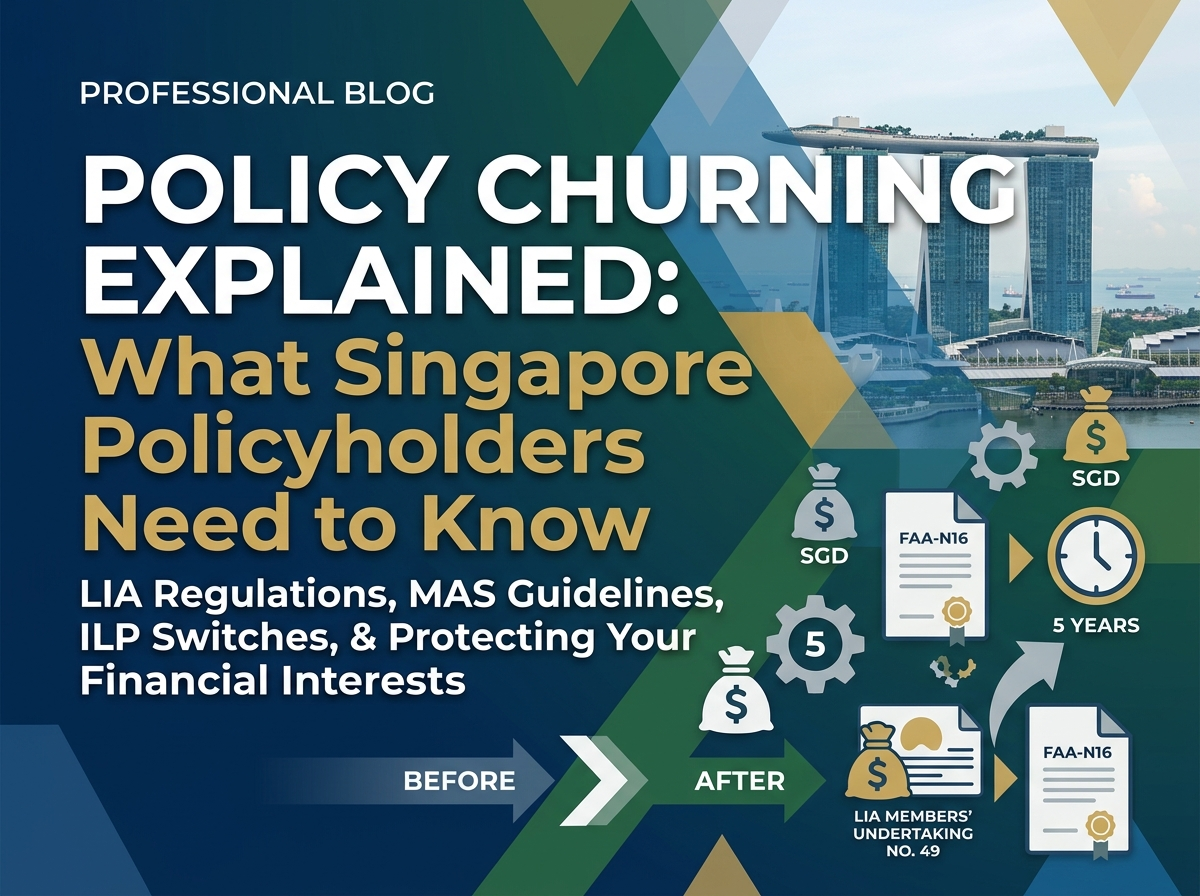
TL;DR — What to Check
- LIA lists "a traditional policy replaced by an investment-linked policy" as a churning indicator — in Members' Undertaking No. 49, alongside surrenders that produce investment losses.
- Detrimental switching is an offence, not just bad practice — under the Financial Advisers Act, per MAS.
- LIA states policies without a fixed duration are expected to be kept for at least five years — a benchmark written into the same undertaking.
- Funding a new policy from the surrender of an old one is itself on the indicator list — as is funding both from the same source, such as CPF.
- From 29 December 2025, representatives must check and document whether a client is aged 62 or older — among other Selected Client criteria.
What Does LIA Actually Define as Churning?
LIA set out the definition in Members' Undertaking No. 49, issued to ordinary and associate members on 21 November 2012. It is not a vague principle. It is a list.
The undertaking states that the practice of churning involves one or more of the following elements, and names among them: different types of policies, whereby a traditional policy is replaced by an investment-linked policy, and more than one insurer, whereby a policy of Insurer A is replaced by a policy of Insurer B.
It then lists mechanisms through which churning may be effected. These include:
- Terminating a policy before its maturity date and buying a new policy
- Surrenders or withdrawals made that resulted in investment losses to the policyholders
- Monies withdrawn from investment-linked policies and reinvested at a higher price
- Old and new policies funded from the same source, such as CPF savings
- Either the new policy or the old one subsequently terminated due to over-commitment arising from the client's purchase of the new policy
On holding periods, the undertaking states plainly that in principle, policies without a fixed duration should be sold on a medium to long term basis and are therefore expected to be kept for at least five years.
The document also tells insurers what to watch for on the adviser side: a high number of replacement cases, and a significant portion of an agent's or broker's cases, production, or earnings coming from replacement activity.
Is Switching Actually Against the Rules?
Switching is not prohibited. Switching that harms the client is an offence.
MAS issued Guidelines on Switching of Designated Investment Products (FAA-G10) on 26 October 2004, last revised 8 October 2018. Announcing them, MAS stated that it is an offence under the Financial Advisers Act for a financial adviser or its representatives to engage in switching activities that are detrimental to the interest of consumers.
A "designated investment product" here includes a life policy. So an endowment or whole life policy replaced by an ILP sits squarely inside the guidelines' scope.
The guidelines cover the controls, processes, and procedures MAS expects firms to have in place to monitor and deter undesirable switching, and include disclosure requirements so that consumers are informed of the costs and implications of switching. MAS also noted at the time that any remuneration structure based solely on sales volume may encourage product pushing and undesirable switching — the reasoning that later produced the Balanced Scorecard Framework, introduced on 1 January 2016.
What Do Singapore Policyholders Describe?
Forum threads carry first-hand accounts of the arithmetic on both sides of a surrender decision.
In a HardwareZone thread from June 2024, a poster set out the full numbers on a 20-year-old ILP bought from a former classmate on entering the workforce: a S$7,000 initial lump sum, S$650 annual premium from CPF, and roughly S$8.50 in annual management charges, for total premiums and charges of S$20,170 over 20 years against a net surrender amount of S$23,127 — a profit of S$2,957 across two decades. Other posters in the same thread described different outcomes, one writing that they surrendered at a large loss.
In an earlier thread, a poster holding two insurance-linked policies with a combined value of S$145,000 noted that surrendering early would leave roughly S$114,000 — a five-figure shortfall — and asked whether exiting was worth it. Replies split between waiting to recover capital and cutting losses.
A 2025 thread titled "Is Selling Investment-Linked Policy ILP Unethical??" contains the commission argument in the posters' own words, including the observation that agents rarely promote term insurance, and a description of walking away from a meeting on seeing an early surrender value of zero.
These are consumer accounts rather than adjudicated findings. What they show is that the surrender arithmetic is the part policyholders find hardest to see before the decision, and easiest to see afterwards.
What Changed for Older Policyholders in December 2025?
Revised MAS Notice FAA-N16 took effect on 29 December 2025, adding checks aimed at clients more likely to be affected by an unsuitable recommendation.
Representatives must now check for and document whether a client is a Selected Client, and make a declaration that the assessment has been performed. The Selected Client criteria include being aged 62 or older, not being proficient in spoken or written English, and holding below GCE O or N level qualifications.
Requirements for pre-transaction checks — supervisor review of documentation and client call-backs — moved from Guidelines FAA-G14 into Notice FAA-N16. As Rajah & Tann notes, that migration matters: breaching a requirement in an MAS Notice is an offence, whereas guidelines carry no equivalent penalty. Call-backs must be recorded, and the independent sales audit unit must review the recordings.
Which Documents Show What a Switch Would Cost?
Three documents carry the figures.
The surrender value statement from the existing insurer states what the policy pays out today, against total premiums paid. The new policy's product summary and Product Highlights Sheet state its charges, including any initial and surrender charges. And any switching disclosure form issued under FAA-G10 states the costs and implications the adviser is required to set out.
If a recommendation has already been acted on, the Financial Industry Disputes Resolution Centre (fidrec.com.sg) handles disputes between consumers and financial institutions, with a jurisdictional limit of S$100,000 for individuals.
Upload both policies to InsureIQ and ask: "What are the total charges on the new policy, and what does my existing policy pay out if I surrender today?" InsureIQ will find both sets of figures and lay them side by side in plain English.
This article is for informational purposes only and does not constitute financial advice. Policy terms vary by insurer and plan. Always refer to your specific policy document for exact coverage details.
Get the next article
New articles on Singapore insurance policy gaps, claim denials, and regulatory changes — delivered to your inbox when published. No spam, no weekly digest.
Free. Unsubscribe any time. InsureIQ will not share your email.