Can I Get Cancer Twice? What the Data Says About Second Cancers in Singapore and Asia
Can I get cancer twice? Yes. Second primary cancers affect 2–8% of survivors and the rate has roughly doubled in forty years. Here is the evidence from Singapore, Japan and Hong Kong.
TL;DR — What to Check
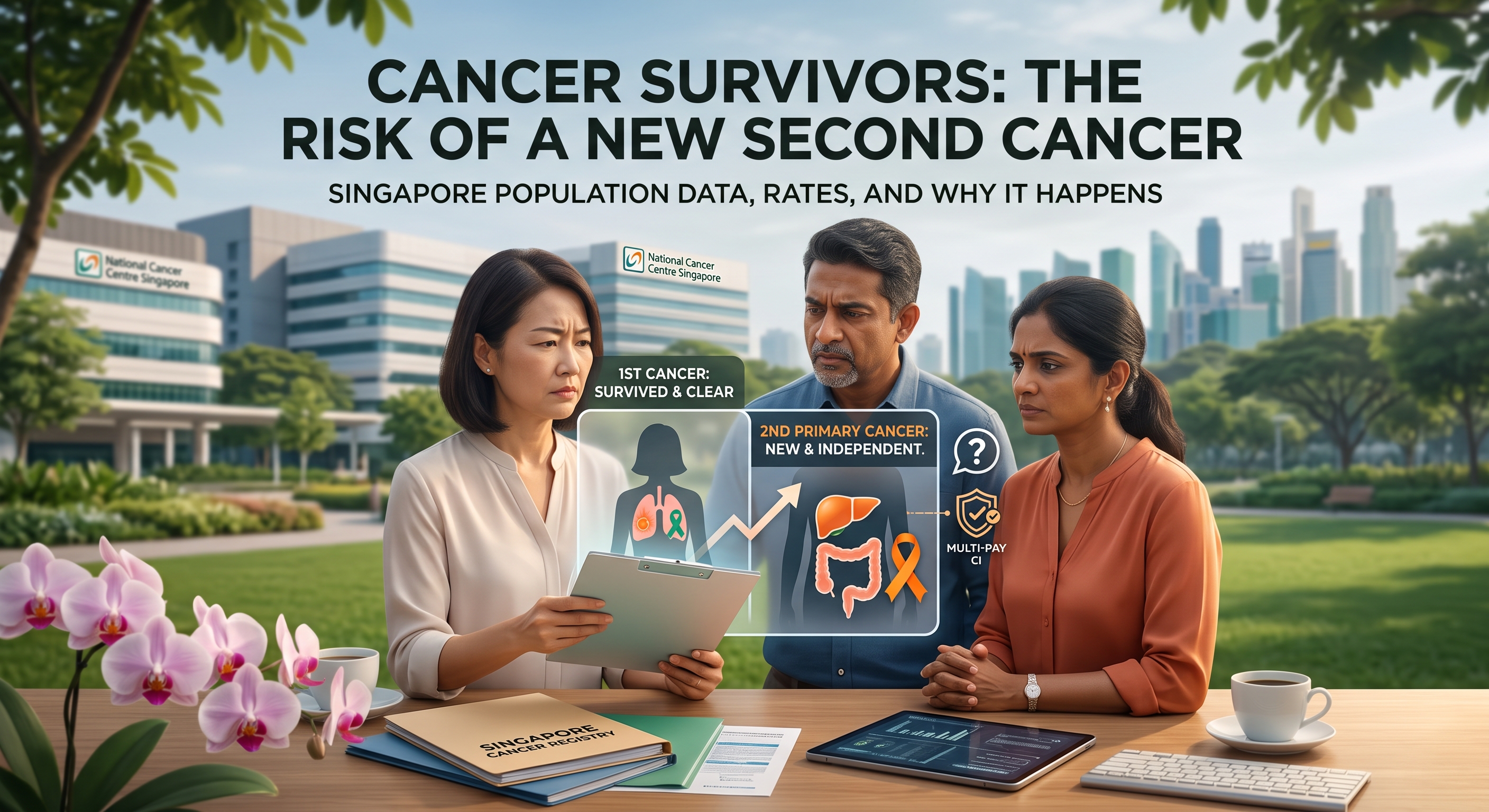
- A second primary cancer is a new cancer, not a return of the first — it is independent of the original tumour, and not a recurrence or a spread.
- Population rates in Asia sit at roughly 2% to 4% — rising to 8% at ten years for some survivor groups, with international reviews reporting 2% to 17% depending on site and follow-up.
- The rate has roughly doubled over four decades — from 2.0% to 3.8% within ten years in Japan's Osaka Cancer Registry, across two study periods.
- The gap between cancers shortens each time — 4.1 years to the second, 2.1 years to the third, 1.6 years to the fourth, in a study of 96,174 Korean patients.
- A new primary, a recurrence and a metastasis are three different things — clinically and contractually. Insurers in Singapore offer multi-pay critical illness products designed to pay more than once, governed by the individual policy wording.
Can I Get Cancer Twice?
Yes. A second primary cancer is a new and independent cancer — not the original one returning or spreading.
That distinction matters clinically and contractually. A recurrence is the first cancer coming back. A metastasis is the first cancer spreading to another organ. A second primary cancer is a separate disease that happens to occur in someone who has already had cancer once.
Kylie Minogue was diagnosed with early-stage breast cancer in May 2005 at age 36, underwent a lumpectomy, chemotherapy and radiotherapy, and was declared cancer-free in 2006. Sixteen years later, in early 2021, she was diagnosed again, picked up during a routine check-up. She has not publicly specified the type.
Which of the three a second diagnosis falls into is a medical determination made by the treating oncologist and pathologist. It is also the distinction that insurance policies are written around.
How Common Is a Second Primary Cancer?
Between 2% and 4% in Asian population studies, rising considerably for certain survivor groups.
| Cohort / Study | Observed Rate | Why It Matters to Policyholders |
|---|---|---|
| Osaka Cancer Registry, Japan (1985–2005) | 3.8% within 10 years | The cleanest like-for-like trend measure available — see the next section |
| Korea Cancer Center Hospital (n=96,174, 2003–2022) | 2.3% across the study period | Large unselected cohort; the closest thing to a general population baseline |
| Breast cancer survivors, South Korea | ~5.9% non-breast second cancer within 10 years | Breast cancer is the most commonly claimed CI condition among women |
| Nasopharyngeal cancer survivors, Hong Kong (n=3,166) | 8.0% at 10 years | NPC is endemic in Southern Chinese populations — demographically closest to Singapore |
| International review range | 2% to 17% | Depends on cancer site, follow-up length, and counting rules |
In the Hong Kong cohort, survivors carried a cancer risk 1.9 times higher than the general population — roughly one additional cancer for every 192 survivors followed for a year. That cohort had all been treated with radiotherapy, which is relevant to the claims discussion further below.
One caution on the numbers. International counting rules differ. Under United States SEER rules, one registry cohort showed 19.7% multiple primaries in colon cancer patients; under International Agency for Research on Cancer rules, the same cohort showed 16.9%. Any single figure needs its source and definition attached — a point that applies equally to policy definitions.
Is the Rate of Second Cancers Rising?
The clearest longitudinal evidence comes from Japan, and it points upward. The Osaka Cancer Registry measured the same thing twice using consistent methods: 2.0% of survivors developed a second primary within 10 years in 1966–1989, rising to 3.8% in 1985–2005. Close to a doubling. Researchers attributed it to improved detection, prolonged survival, and an ageing survivor population.
Singapore's own data shows the mechanism at work. According to the Singapore Cancer Registry Annual Report 2023, five-year survival for all cancers improved from 22.6% in 1978–1982 to 61.4% in 2019–2023.
More people surviving, for longer, means more person-years lived during which a second cancer can occur. The rise in second primaries is in part a consequence of success against the first — and it is the trend that multi-pay products were designed around.
Why Does a Second Cancer Happen?
Six mechanisms appear consistently in the research. They overlap — most cases likely involve more than one.
Longer survival. The most direct driver. Fifteen years after diagnosis, second primaries were found in fewer than 5% of patients with poor-prognosis cancers such as pancreatic or gastric — not because risk was lower, but because fewer patients lived long enough.
Radiotherapy. Approximately 6.6% of second solid cancers in breast cancer survivors may be attributable to radiotherapy. In the Hong Kong nasopharyngeal study, re-irradiation was an independent risk factor for a second cancer arising within the treated field.
Chemotherapy. Secondary leukaemia and myelodysplastic syndromes are associated with certain combination chemotherapy agents in a dose-dependent manner. The evidence is not uniformly adverse — in one large breast cancer cohort, chemotherapy was associated with lower risk of some second cancers and higher risk of others.
A note on classification. Secondary leukaemia following treatment for a solid tumour is a blood cancer arising in different tissue. Clinically it is a new primary, not the original cancer returning.
Inherited predisposition. Multiple primary cancers are treated clinically as a possible marker of hereditary cancer syndrome. This is relevant in Singapore: National Cancer Centre Singapore reports that roughly 1 in 150 Singaporeans carry a pathogenic variant linked to hereditary breast and ovarian cancer, against an estimated 1 in 400 to 500 elsewhere.
Shared risk factors. Where one exposure damages an entire tissue area — the concept of field cancerisation, first described in 1953 — multiple independent tumours can arise from it. Head and neck cancer patients show sharply elevated risks of lung, oesophageal and further head and neck tumours. Smoking, alcohol and obesity are the common drivers.
A note on classification. Field cancerisation produces the hardest diagnostic question in this area. A second tumour in the same anatomical region can be a genuinely new primary, a recurrence of the first, or a metastasis. Distinguishing between them relies on pathology and imaging evidence.
Surveillance. Part of the measured increase is detection, not biology. In a Scottish registry study, cancer incidence in the first 60 days after an initial diagnosis was 2.36 times expected. Once that window was excluded, overall risk was not raised — though it remained elevated for specific groups, including women under 50 with breast cancer.
A note on interpreting this. A second cancer found within weeks of the first is more likely to have been detected by staging scans than to have newly developed. Where two cancers are diagnosed close together, that timing is clinically significant in determining whether they are genuinely separate events.
What Does the Research Say About Singapore Specifically?
Singapore-specific data on multiple primary cancers is limited, and the one available study covers a selected group rather than the population.
A study published in ESMO Open in March 2025 examined 3,514 cancer patients at the National University Cancer Institute cancer genetics clinic between 2000 and 2023. Of those, 668 — 19% — had multiple primary cancers; 85.3% had two and 14.7% had three or more.
That 19% is not Singapore's population rate. Patients were referred on suspicion of hereditary cancer syndrome — in some cases precisely because they had already had more than one cancer. The population figure is closer to the 2% to 4% range seen in Korea and Japan.
Two findings do carry more generally. MPC patients developed their first cancer at a median age of 45, against 54 for single-cancer patients — inside the age band where CI cover is most likely to be in force. And the most common combination was breast followed by breast, at 33.2% of pairs.
How Long Is the Gap Between One Cancer and the Next?
It shortens with each successive cancer. In the Korean study of 96,174 patients, median latency was 4.1 years from first to second primary, 2.1 years from second to third, and 1.6 years from third to fourth.
Kylie Minogue's sixteen-year interval sits well above the median. Long gaps and short gaps both occur.
Insurers in Singapore offer multi-pay or multi-claim critical illness products, which are structured to pay out more than once across the policy term. Whether any given second diagnosis results in a second payout is governed by the individual policy wording, which varies between insurers and between product generations.
Upload your policy to InsureIQ and ask: "How does my policy define a subsequent cancer claim?" InsureIQ will find the relevant clauses and set out what they say in plain English.
This article is for informational purposes only and does not constitute financial advice. Policy terms vary by insurer and plan. Always refer to your specific policy document for exact coverage details.
Get the next article
New articles on Singapore insurance policy gaps, claim denials, and regulatory changes — delivered to your inbox when published. No spam, no weekly digest.
Free. Unsubscribe any time. InsureIQ will not share your email.